Why Does My DPF Keep Blocking After Regeneration?

Updated: Sep 8
If your diesel particulate filter (DPF) keeps blocking shortly after a regeneration, you're not alone. Many drivers assume a forced regeneration permanently fixes a blocked DPF, only to see the warning light return days or even hours later. In reality, regeneration is only one part of the solution. If the underlying fault isn't identified, the DPF will simply continue to fill with soot until the problem comes back.

DPF King regularly investigates vehicles that have already undergone one or more regenerations but continue to develop the same warning lights or soot-loading problems. Diagnostic testing, live-data analysis and DPF differential-pressure readings can help establish whether the filter is genuinely restricted or whether an underlying fault is causing the problem to return.

What Does a DPF Regeneration Actually Do?
A diesel particulate filter is designed to capture soot particles produced during normal engine operation. As soot builds up, the engine management system periodically performs a regeneration to burn these deposits into a much smaller amount of ash.
There are several types of regeneration:
Passive Regeneration
Passive regeneration happens naturally during longer journeys when exhaust temperatures become high enough to burn soot continuously.
This normally occurs during:
Motorway driving
Dual carriageway journeys
Sustained driving with the engine fully up to operating temperature
Many vehicles that regularly travel longer distances complete passive regenerations without the driver ever noticing.
Active Regeneration
If the vehicle is mainly used for shorter journeys, the engine control unit starts an active regeneration.
During this process the vehicle may:
Inject additional fuel
Increase exhaust gas temperatures
Raise engine idle speed
Switch on cooling fans
Delay automatic stop/start operation
If the driver interrupts this process repeatedly by switching the engine off too soon, regeneration may fail before the soot has been fully removed.
Forced Regeneration
A forced regeneration is carried out using professional diagnostic equipment.
This procedure raises exhaust temperatures under controlled conditions to burn accumulated soot from the filter.
While a forced regeneration can often reduce soot loading, it does not repair the fault that caused the blockage in the first place.
That is why some vehicles return with exactly the same warning lights only days later.
Why Does the DPF Keep Blocking Again?
This is one of the most common questions we hear from customers.
The answer is simple.
A regeneration removes soot.
It does not repair faulty sensors, boost leaks, injector problems, EGR faults or engine issues that continually produce excessive soot.
If those faults remain, the filter simply fills up again.
Think of it like emptying a bucket while leaving the tap running.
Unless the cause is repaired, the blockage will always return.
The Most Common Reasons a DPF Blocks Again
1. The Original Fault Was Never Diagnosed
Many garages perform a forced regeneration without checking why the soot loading increased.
This can temporarily switch the warning light off but rarely fixes the actual problem.
Professional diagnostics should always include:
Live data analysis
Differential pressure readings
Exhaust temperature monitoring
Soot load calculations
Calculated ash-load data where available
Sensor testing
Fault code interpretation
Regeneration history
At DPF King we assess the complete DPF system rather than simply clearing fault codes.
If you'd like to understand how we identify these faults, visit our DPF Diagnostics page, where we explain the live testing and pressure checks carried out before recommending any repair.
2. The Vehicle Only Does Short Journeys
Modern diesel vehicles are designed to complete regular regenerations.
Unfortunately, many vehicles spend their lives driving:
Around town
On school runs
Between short work locations
In slow-moving traffic
On repeated cold starts
These driving conditions rarely allow exhaust temperatures to become high enough for a successful regeneration.
The result is repeated soot build-up.
Over time the engine attempts more frequent regenerations until eventually they begin to fail altogether.
Commercial vans, taxis and delivery vehicles are particularly vulnerable because they often spend long periods idling or travelling short distances.
3. A Faulty Differential Pressure Sensor
One of the most common causes of repeat DPF problems is a faulty differential pressure sensor.
This sensor measures exhaust pressure before and after the DPF.
The engine management system uses these readings to calculate how blocked the filter has become.
If inaccurate readings are supplied, the ECU may:
Cancel regeneration
Start regeneration too late
Regenerate unnecessarily
Display incorrect DPF warnings
Enter limp mode
Without testing live sensor data, replacing the DPF alone will rarely solve the problem.
4. Split or Blocked Pressure Pipes
The pressure sensor relies on two small pressure pipes connected to the DPF.
Over time these pipes can become:
Blocked with soot
Cracked
Melted
Split
Detached
A damaged pressure pipe often produces incorrect pressure readings even when the DPF itself is in good condition.
This is why physical inspection forms an important part of every professional diagnosis.
5. EGR Valve Problems
The Exhaust Gas Recirculation (EGR) valve helps reduce emissions by returning a controlled amount of exhaust gas back into the engine.
When the valve sticks open or becomes contaminated with carbon deposits, combustion efficiency drops.
This often results in:
Increased soot production
More frequent regenerations
Excessive smoke
Reduced engine performance
Faster DPF blockage
Where an EGR fault is contributing to excessive soot production or failed regeneration, that underlying problem should be investigated before DPF treatment is considered.
6. Turbocharger Problems Increase Soot Production
A faulty turbocharger can have a major impact on DPF performance. If the turbo is not supplying the correct boost pressure, the engine cannot burn fuel efficiently, resulting in excessive soot entering the DPF.
Common turbo-related faults include:
Worn turbocharger bearings
Sticking variable vane mechanisms
Boost leaks
Split intercooler hoses
Damaged boost pipes
Faulty boost pressure sensors
Symptoms often include reduced engine power, poor acceleration, black smoke and repeated DPF warning lights.
Professional diagnostics allow these faults to be identified before unnecessary DPF replacement is considered.
7. Faulty Fuel Injectors
Diesel injectors must deliver the correct amount of fuel at precisely the right time.
When injectors begin to wear or leak, combustion becomes less efficient and soot production increases dramatically.
Signs of injector problems include:
Rough idle
Hard starting
Increased fuel consumption
Excessive exhaust smoke
Frequent regenerations
Recurring DPF faults
Simply carrying out another regeneration without checking injector performance usually results in the filter blocking again.
8. Excessive Ash Loading
Unlike soot, ash cannot be burned away during regeneration.
Ash gradually accumulates inside the DPF over many thousands of miles and comes from sources such as:
Engine oil additives
Normal engine wear
Combustion residues
Some vehicles provide calculated ash-load or service-life information that can help form part of the assessment, although the data available varies between manufacturers. Filter condition, mileage, pressure readings and the vehicle's overall operating history may also need to be considered.
9. Engine Never Reaches Operating Temperature
Many drivers are surprised to discover that a faulty thermostat can cause recurring DPF problems.
If the engine runs too cool:
Regeneration temperatures may never be achieved.
Fuel economy often worsens.
Soot production increases.
Active regenerations become more frequent.
The DPF fills much faster.
Replacing a faulty thermostat is often far less expensive than replacing a DPF that has repeatedly become blocked.
10. Poor Vehicle Maintenance
A poorly maintained diesel engine naturally produces more soot.
Items that can contribute include:
Dirty air filters
Incorrect engine oil
Worn glow plugs
Vacuum leaks
Intake system contamination
Poor servicing history
Keeping your vehicle serviced according to the manufacturer's schedule helps reduce soot production and prolong DPF life.
Why Repeated Forced Regenerations Are Not a Long-Term Fix
A forced regeneration can reduce accumulated soot when the vehicle and DPF are in suitable condition, but it does not repair the fault that caused regeneration to fail in the first place.
If an underlying sensor, pressure, temperature, airflow or engine fault remains, another regeneration may provide only a temporary improvement before the DPF begins filling again.
Repeated forced regenerations should therefore not be treated as a substitute for proper fault diagnosis.
Before another regeneration is attempted, it is important to establish why previous regeneration has failed and whether the vehicle is capable of completing the process correctly.
For more information about when regeneration may be appropriate, see our DPF Regeneration Service.
How Recurring DPF Problems Are Diagnosed
Finding the cause of repeated DPF blockage requires more than simply reading and clearing fault codes.
Depending on the vehicle and symptoms, diagnostic testing may include:
ECU fault-code scanning
Live-data analysis
Differential-pressure testing
Calculated soot-loading checks
Exhaust-temperature monitoring
Regeneration-history checks
Pressure-sensor and pipe inspection
Engine and emissions-system checks
Road testing where appropriate
These checks help establish whether the DPF itself is restricted and, equally importantly, whether another fault is responsible for the recurring problem.
For more information, see our DPF Diagnostics page.
When Professional DPF Cleaning May Be Appropriate
If diagnostic testing confirms that the DPF is genuinely restricted but remains suitable for treatment, professional cleaning may be appropriate.
At DPF King, we assess the vehicle before recommending cleaning. This can include fault-code scanning, live-data analysis, calculated soot loading and DPF differential-pressure testing.
Where on-vehicle treatment is suitable, the process may include:
Diagnostic assessment
Pressure testing before treatment
Professional chemical DPF cleaning
Live-data monitoring
Controlled regeneration where appropriate
Post-treatment pressure and data checks
The aim is not simply to switch off a warning light. The condition of the filter needs to be considered alongside any fault that could cause the DPF to become restricted again.
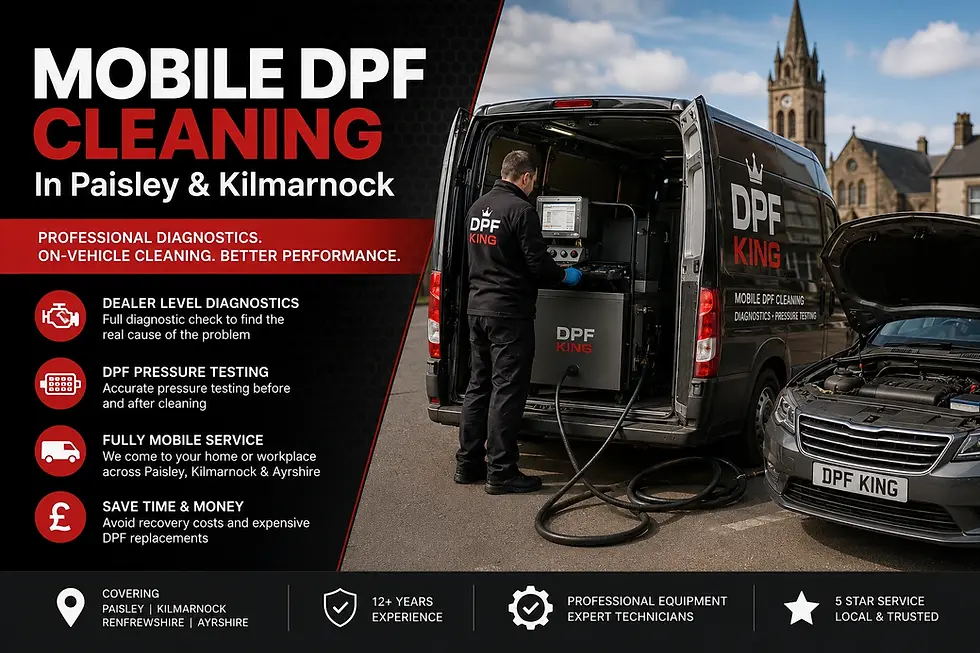
Learn more about our Mobile DPF Cleaning service.
Related DPF Information and Services
DPF Diagnostics
Live-data analysis, pressure testing and system checks can help identify why a DPF repeatedly blocks or fails to regenerate.
Mobile DPF Cleaning
Where diagnostic testing confirms that the filter is restricted and suitable for treatment, professional on-vehicle DPF cleaning may be appropriate.
DPF Regeneration
Regeneration may be appropriate where diagnostic testing confirms that the vehicle and DPF are in suitable condition and there are no faults likely to prevent the process from completing successfully.
Why Does My DPF Keep Blocking After Regeneration? – Final Answer
If a DPF keeps blocking shortly after regeneration, the filter may not be the original cause of the problem.
Regeneration burns accumulated soot, but it cannot repair faulty pressure sensors, blocked pressure pipes, exhaust-temperature sensor faults, EGR problems, boost faults, injector issues or other engine conditions that interfere with regeneration or increase soot production.
The correct approach is to establish why the DPF became restricted, confirm the condition of the filter and address any underlying fault before repeatedly attempting regeneration or replacing expensive components.
If your DPF warning light keeps returning or regeneration repeatedly fails, professional diagnostic testing can help identify the cause and determine the appropriate next step.
At DPF King, regeneration is only recommended after checking live vehicle data and confirming that it is appropriate for the condition of the DPF and the engine.
You can find out more about when a regeneration is the correct solution by visiting our Regeneration Service page.
When Professional DPF Cleaning May Be Appropriate
If testing confirms that the DPF is heavily contaminated with soot but remains structurally sound, professional on-vehicle cleaning is often the most cost-effective option.
Our Mobile DPF Cleaning service includes:
Advanced diagnostics
Pressure testing before cleaning
Professional chemical cleaning
Live data monitoring
ECU checks
Regeneration where required
Pressure testing after cleaning
The aim is not simply to clear the warning light but to restore the DPF's performance while identifying any faults that could cause the problem to return.
Warning Signs You Shouldn't Ignore
Arrange a professional inspection if you notice:
The DPF warning light keeps returning.
Regeneration repeatedly fails.
Your vehicle enters limp mode.
Engine power has reduced.
Fuel consumption has increased.
Fault codes return after being cleared.
The cooling fan runs frequently after switching off.
Regenerations are becoming more frequent.
If these symptoms keep returning after regeneration, diagnostic testing can help establish whether the filter is genuinely restricted or whether another fault is preventing the system from operating correctly.
Frequently Asked Questions
Can a DPF block again after a successful regeneration?
Yes. If the underlying cause of excessive soot production has not been repaired, the DPF can begin blocking again very quickly. A regeneration removes soot already inside the filter but does not fix faults such as failed sensors, injector problems, EGR faults or turbocharger issues.
How many times can a DPF regenerate?
There is no fixed limit. Modern diesel vehicles are designed to regenerate many times throughout their life. However, if regenerations become increasingly frequent, it usually indicates an underlying problem that requires professional diagnosis.
Is it safe to keep driving with the DPF warning light on?
That depends on the vehicle, the warning displayed and any other symptoms present. Drivers should follow the guidance in the vehicle handbook. If the warning remains illuminated, regeneration repeatedly fails, the vehicle enters limp mode or additional engine-management warnings appear, the cause should be investigated rather than repeatedly attempting to clear the problem by driving.
Diagnostic testing can establish whether the DPF is genuinely restricted or whether another fault is responsible.
Will replacing the DPF solve the problem?
Not always.
If the fault causing the excessive soot production has not been identified, even a brand-new DPF may eventually become blocked. This is why diagnosing the root cause is always more important than replacing parts unnecessarily.
Can I prevent my DPF from blocking?
While no DPF is completely maintenance-free, you can reduce the risk of blockages by:
Driving longer distances when possible.
Keeping up with regular vehicle servicing.
Using the correct engine oil.
Avoiding repeated interruption of active regenerations.
Having warning lights investigated promptly.
Repairing engine faults before they affect the DPF.
Good maintenance significantly increases the lifespan of both the DPF and other emission system components.
Related DPF Information and Services
If you're experiencing recurring DPF problems, these services may help:
Mobile DPF Cleaning
If testing shows your DPF is heavily contaminated with soot but remains suitable for cleaning, our professional mobile cleaning service can restore performance without removing the filter from the vehicle.
Internal link: https://www.dpf-king.co.uk/mobile-dpf-cleaning
DPF Regeneration Service
Where conditions are suitable, we can carry out a controlled regeneration after confirming there are no faults likely to cause it to fail.
Internal link: https://www.dpf-king.co.uk/regeneration-service
DPF Diagnostics
Using professional diagnostic equipment, live data and pressure testing, we identify the root cause of recurring DPF faults before recommending repairs.
Internal link: https://www.dpf-king.co.uk/dpf-diagnostics