Broken AdBlue Injector Wiring: How It Can Stop DPF Regeneration


A broken wire at an AdBlue injector may appear to be unrelated to the diesel particulate filter, but modern diesel emissions systems do not operate as completely separate components. The engine control unit monitors the DPF, AdBlue system, sensors and exhaust temperatures together. When an important emissions fault becomes active, the vehicle may postpone or prevent DPF regeneration because the required operating conditions cannot be confirmed.
This can leave the driver with an AdBlue warning, engine-management light, failed regeneration and a rapidly increasing calculated soot level. Cleaning the DPF without finding the wiring fault may provide only a temporary improvement. The cause must be diagnosed and repaired before the regeneration system can be assessed properly.
What Does the AdBlue Injector Do?
The AdBlue injector forms part of the selective catalytic reduction system, normally shortened to SCR. It meters a controlled amount of AdBlue into the exhaust, where the fluid helps the SCR catalyst reduce nitrogen oxide emissions.
The engine control unit uses information from several sensors to decide when and how much AdBlue should be injected. The system can monitor the injector circuit, exhaust temperature, NOx sensor information and other operating conditions. If the injector wiring becomes open circuit, shorted or intermittent, the control unit may record an emissions fault because it can no longer operate or monitor the injector correctly.
The SCR system and DPF perform different jobs, but both are part of the vehicle’s wider exhaust after-treatment system. This is why an electrical fault affecting the AdBlue system can sometimes influence regeneration strategy, warning lights and the calculated condition of the DPF.
For a straightforward explanation of the filter itself, see our guide to how a diesel particulate filter works.
Can an AdBlue Wiring Fault Stop DPF Regeneration?
Depending on the vehicle and the fault stored, an active AdBlue or SCR fault can prevent the engine control unit from completing a normal regeneration. Regeneration requires the vehicle to meet a defined set of conditions, including suitable exhaust temperatures, reliable sensor information and the absence of certain engine or emissions faults.
If the control unit detects a broken AdBlue injector wire, it may register an open-circuit or performance fault. On some vehicles, regeneration will then be inhibited until the electrical problem is repaired and the system can be tested again.
Soot continues to accumulate while regeneration is unavailable. The ECU-calculated soot mass may rise with each journey, particularly when the vehicle is mainly used for short trips or stop-start driving. Eventually, the driver may see a DPF warning, reduced performance or limp mode in addition to the original AdBlue warning.
This does not mean that every AdBlue fault automatically blocks a DPF. The effect depends on the manufacturer, engine-management strategy and fault status. It is therefore important to examine the fault codes and live data from the individual vehicle rather than making a diagnosis from the dashboard warning alone.
Signs of a Broken AdBlue Injector Wire
The exact symptoms vary between vehicles, and some wiring faults begin as intermittent problems before becoming permanent. Possible warning signs include:
An AdBlue or SCR warning on the dashboard
An engine-management light
A stored open-circuit or injector-control fault
An AdBlue range or restart warning
Repeatedly unsuccessful DPF regeneration
Increasing ECU-calculated soot loading
Reduced engine performance or limp mode
Warning lights that return soon after being cleared
These symptoms can also be caused by a failed injector, damaged connector, power-supply problem, control fault or another component within the emissions system. A fault code identifies the circuit or system requiring investigation; it does not always prove that the named component needs to be replaced.
That distinction matters. Replacing an AdBlue injector will not repair a broken wire, just as cleaning the DPF will not repair the electrical fault that stopped regeneration.
Why Cleaning the DPF Alone Does Not Fix the Problem
High soot loading is often the result of another fault rather than the original problem. If the DPF is cleaned while the AdBlue injector circuit remains open, the vehicle may still be unable to regenerate normally. The calculated soot level can begin rising again, warning lights may return and the customer may believe the cleaning procedure has failed.
Before cleaning, the technician should establish why regeneration stopped and whether the filter is genuinely restricted. This normally involves checking stored fault information, calculated soot loading, differential pressure, exhaust temperatures and relevant live data.
The readings need to be considered together. A high calculated soot value does not always mean the filter has the same level of physical restriction, while normal pressure does not automatically mean that every part of the regeneration system is working correctly.
This diagnostic-first approach helps separate the cause from the consequence:
Cause: broken wiring prevents correct AdBlue injector operation and can inhibit regeneration.
Consequence: unsuccessful regeneration allows calculated soot loading to increase.
Correct solution: repair and verify the electrical fault, assess the DPF and clean only when testing shows that it is appropriate.
Jaguar F-Pace 2.0 Ingenium: A Recent Wiring-Fault Case
During a recent mobile appointment, we assessed a Jaguar F-Pace fitted with the 2.0-litre Ingenium diesel engine. The vehicle had developed emissions warnings and was no longer completing successful DPF regeneration. Live data showed a high ECU-calculated soot content, but the reason for the failed regeneration first had to be established.
Diagnostic testing identified a broken wire at the AdBlue injector. The damaged wiring had created an open-circuit fault within the SCR system, preventing the injector circuit from operating correctly. With the emissions fault active, the vehicle was unable to complete the regeneration process, allowing soot loading to continue increasing.
The damaged wire was repaired and the injector circuit was checked to confirm that it was operating correctly. Only after the underlying fault had been addressed did we assess whether the DPF was suitable for on-vehicle chemical cleaning.
The treatment was completed with the filter still fitted to the vehicle. We then rechecked the calculated soot level, differential pressure, exhaust-temperature information and relevant fault data. The final readings showed a clear improvement, and an unnecessary DPF replacement was avoided.
This job is a useful example of why a warning light should not lead directly to forced regeneration, chemical cleaning or filter replacement. The broken wire was the fault that needed to be found; the high soot content was a result of regeneration being unavailable.
You can see other genuine examples on our recent DPF cleaning jobs page.
How an AdBlue Injector Wiring Fault Is Checked
A reliable diagnosis should follow the evidence rather than relying on one fault code. The exact procedure varies by vehicle, but the assessment may include the following checks.
Fault Codes and Freeze-Frame Information
Stored and current fault codes help identify which circuit has failed and when the problem was detected. Freeze-frame information can show engine conditions at the time the fault was recorded. Clearing the code without investigating it may temporarily remove the warning, but it does not repair damaged wiring.
Wiring, Connector and Terminal Inspection
The harness near the exhaust is exposed to heat, water, road contamination and vibration. Wiring can break internally, insulation can become damaged and terminals can corrode or lose tension. A careful visual inspection may reveal a clear break, but an intermittent fault can require circuit testing before the damaged section is found.
Injector-Circuit Testing
The technician may check power, control, continuity and the condition of the connector, following appropriate vehicle information. This helps distinguish a wiring fault from a failed injector or control problem. Repairs should be properly insulated, supported and protected from exhaust heat and movement.
DPF Pressure, Soot and Temperature Data
The filter still needs to be assessed separately. Differential-pressure readings, ECU-calculated soot loading and exhaust-temperature data help determine whether the DPF is suitable for cleaning. The technician should also consider other faults that could stop regeneration, including EGR, MAF, pressure-sensor, cooling-fan and exhaust-temperature problems.
Can the DPF Be Cleaned After the Wiring Repair?
In many cases, yes, provided the filter is structurally sound and testing confirms that on-vehicle cleaning is appropriate. Repairing the wire restores the affected electrical circuit, but it does not automatically remove the soot accumulated during the failed regeneration attempts.
The next step depends on the test results. A moderately loaded filter may be able to resume normal operation once the fault is repaired. A filter with heavier soot accumulation may require professional chemical treatment. A controlled regeneration should only be considered when it is needed or requested as part of the mobile service, and only when the vehicle is safe and all required operating conditions are satisfied.
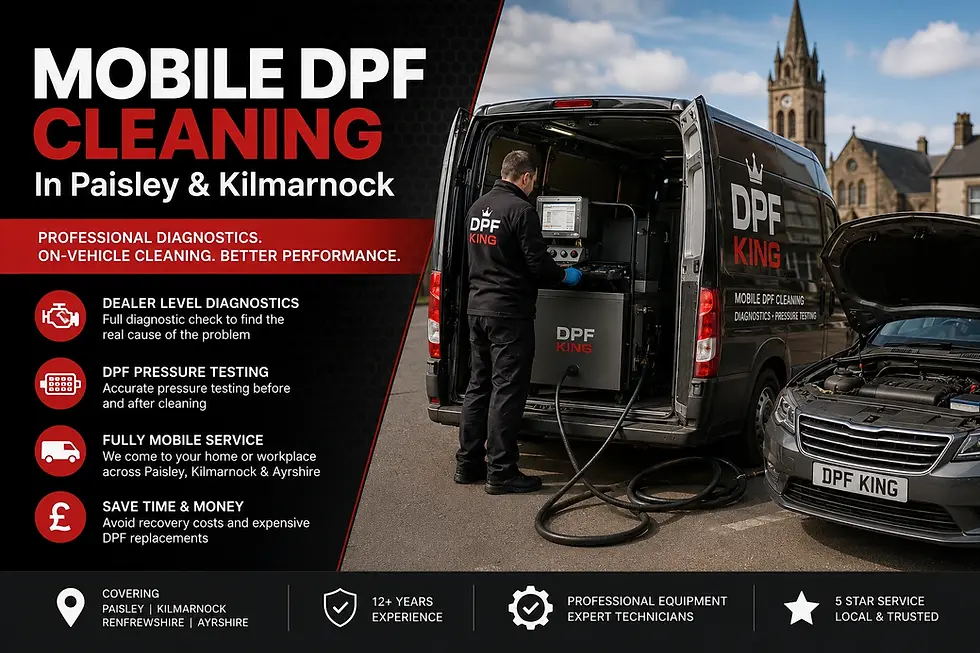
DPF King uses a 1-litre treatment for standard cleaning and a 2-litre treatment where test results indicate heavier contamination. The filter remains fitted to the vehicle. Final live-data and pressure checks are used to assess the result rather than assuming that clearing the warning light proves the system is fixed.
You can read more about our on-vehicle mobile DPF cleaning process.
Preventing the Fault From Returning
An electrical repair near the exhaust must be completed carefully. Heat, vibration and moisture can quickly damage an unsuitable repair. The repaired wiring should be routed correctly, secured away from hot or moving components and protected with appropriate automotive materials.
After repair, the injector circuit and related live data should be checked again. Remaining emissions faults must not be ignored, because another active fault may continue to affect regeneration. The vehicle also needs to be used in a way that allows its normal regeneration strategy to operate, although longer journeys cannot compensate for an unresolved electrical or sensor problem.
Most importantly, drivers should avoid repeatedly clearing warnings or attempting forced regeneration without understanding why the system stopped working. Early investigation can prevent a small wiring defect from developing into high soot loading, limp mode and unnecessary filter replacement.
When to Arrange a Diagnostic-Led DPF Appointment
Seek professional assistance when an AdBlue warning appears alongside a DPF light, regeneration repeatedly fails or calculated soot loading continues to rise. The safest approach is to identify the electrical or emissions fault first and then decide whether the filter requires cleaning.
If you are based within the county, DPF King provides diagnostic-led mobile DPF cleaning in Renfrewshire for diesel cars, vans and light commercial vehicles. Testing is carried out as part of the appointment to establish whether on-vehicle cleaning is suitable.
Call 07870 751782 to discuss the warning lights and vehicle symptoms.